Working with Phantom and git
Make sure you have the git version control system installed.
Getting your first copy (if you just want to use the code)
If you just want to use the code, you can get the latest stable version using:
git clone https://github.com/danieljprice/phantom.git
Getting your first copy (if you plan to edit anything in the source code)
Once you have a GitHub account, you must create your own fork. This is done using the “fork” button (the big button on top right of the repo page):

To read/write via ssh you will also need to add your public ssh key to github:
cd ~/.ssh
cat id_rsa.pub
... some long key is printed ...
If you don’t have an ssh key, you can generate one using:
ssh-keygen
... follow the prompts, you can just press enter to accept the defaults ...
cat ~/.ssh/id_ed25519.pub
Copy everything that was printed above and paste it into the relevant box under User Icon->Settings->SSH and GPG keys->New SSH key, with a name like “my-laptop” or whatever the machine you are currently working on is called:
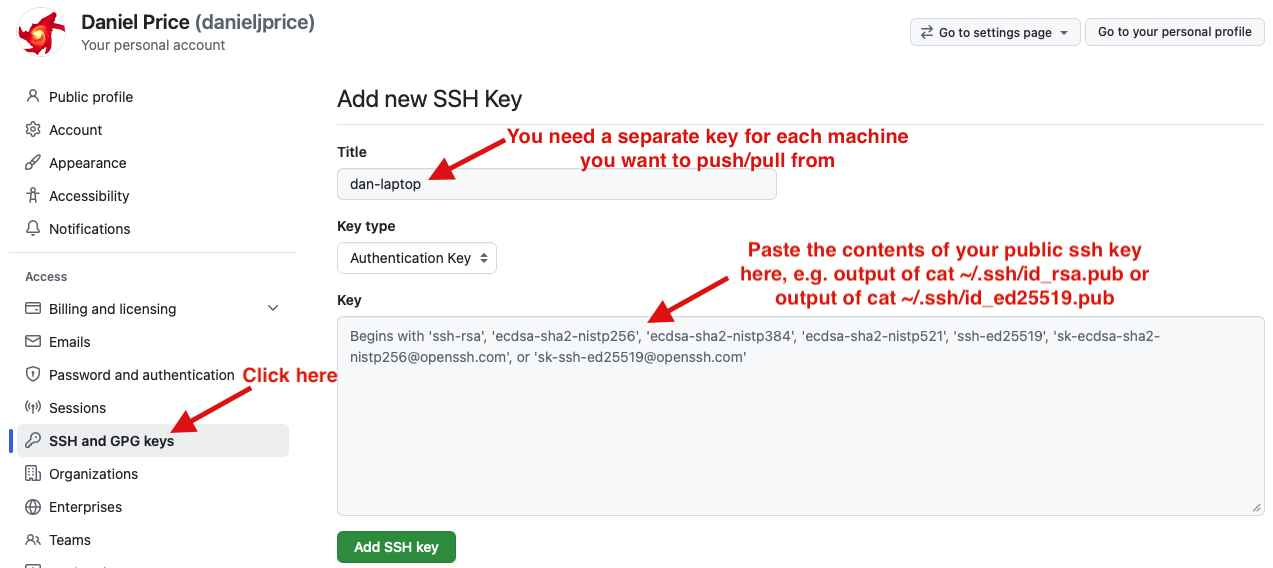
You will need to do this once from every machine you want to push changes from.
You can then clone your fork to your computer:
git clone git@github.com:USERNAME/phantom.git
This gets a copy of the entire phantom repository. Obviously replace USERNAME with your GitHub username.
Setting your username and email address
Before you can push changes, you must ensure that your name and email address are set, as follows:
cd phantom
git config --global user.name "Joe Bloggs"
git config --global user.email "joe.bloggs@monash.edu"
Please use your full name in the format above, as this is what appears in the commit logs (and in the AUTHORS file)
Receiving updates from your fork
Procedure is: stash your changes, pull the updates, reapply your changes:
git stash
git pull
git stash pop
Receiving updates from the master branch
To receive updates from the main repo, you can add a branch linking your fork to the main repo (here denoted “upstream”):
git remote add upstream https://github.com/danieljprice/phantom.git
This only needs to be done once.
To update, the procedure is: stash your changes, pull the updates, reapply your changes:
git stash
git fetch upstream
git merge upstream/master
git stash pop
This will update your fork on your local machine only.
Committing changes to your fork
Submit changes to Phantom carefully! The first thing is to pull any upstream changes as described above. Once you have done this, first check what you will commit:
git diff
then go through each subset of changes you have made and commit the file(s) with a message:
git commit -m 'changed units in dim file for problem x' src/main/dim_myprob.f90
and so on, for all the files that you want to commit. Then, when you’re ready to push the changeset back to your fork use:
git push
Note that you will only be allowed to push changes if you have already updated your copy to the latest version.
If you have just updated your code from the master repo, simply update your fork via:
git commit -m 'merge'
git push
This will push all the remote changes to your forked version of Phantom.
Contributing to community development of the public code
This is done through a “pull request”. To do this, you can click the “Contribute” button on the GitHub page to request that your changes be pulled into the master copy of Phantom. Please do this frequently. Many small pull requests are much better than one giant pull request!
Automated tests will be performed on all pull requests to ensure nothing gets broken. Once these pass and the code has been reviewed, the code can be merged.